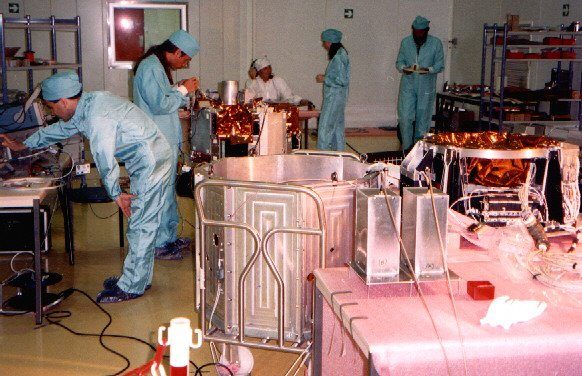
YES1 / TEAMSAT
ESA’s first true skunkworks satellite, developed by Delta-Utec: a 200 kg satellite in GTO with a 35 km double-strand tether and a range of technology demonstrations.
Read more
Space experiments and small satellites
A 36 kg student-built tether satellite on ESA’s Foton-M3 mission that deployed a 32 km tether to deorbit the re-entry capsule “Fotino” – a Guinness World Record.
Ten years after YES, the successor, the Young Engineers’ Satellite 2 (YES2) was flown. YES2 was a 36 kg student-built tether satellite, part of ESA’s Foton-M3 microgravity mission. The YES2 satellite employed a 32 km long tether to deorbit a small re-entry capsule, “Fotino”.
At an altitude of 260 to 300 kilometres, a half-millimetre thick, thirty-kilometre long tether rolled out below Foton. This is so long that the tether was visible from Earth in the night sky (from South America and eastern Russia), at several times the apparent size of the Moon.
At the end of the tether was attached the spherical re-entry capsule Fotino (the parcel). Gravity caused Fotino to swing forwards and back to the vertical in a controlled manner. At the right moment Fotino was released from the tether and the slingshot placed the capsule on a path towards the Earth’s atmosphere. An ultra-light heat shield was designed and qualified to protect the experiment against the same heat the Space Shuttle faces during its return to Earth. Fotino was equipped with a parachute to automatically deploy for a soft landing.
The YES2 satellite was launched on 14 September 2007 from Baikonur. Although the capsule was lost because the beacon system failed, deployment telemetry indicated that the tether deployed to full length and that the capsule presumably deorbited as planned. It has been calculated that Fotino was inserted into a trajectory towards a landing site in Kazakhstan.
ESA’s first true skunkworks satellite, developed by Delta-Utec: a 200 kg satellite in GTO with a 35 km double-strand tether and a range of technology demonstrations.
Read more
JAXA sounding-rocket experiment that demonstrated the first deployment of a bare electrodynamic tape tether – a step towards propellantless propulsion in LEO.
Read more